Critical Limb Ischemia (CLI)
Critical limb ischemia is the most advanced stage of peripheral artery disease, when blood flow to a leg or foot is so reduced that tissue is at risk of being lost. At MVM, our limb-preservation focus means many patients told they need amputation are candidates for revascularization instead.
What is critical limb ischemia?
Critical limb ischemia (CLI), also called chronic limb-threatening ischemia (CLTI), is the most advanced stage of peripheral artery disease. The arteries to the leg or foot have become so narrowed that blood flow is no longer enough to sustain tissue, even at rest.
Patients typically present with constant pain in the foot at rest, especially at night when the leg is elevated; non-healing wounds on the toes, foot, or lower leg; or actual tissue loss (gangrene). Without restored blood flow, these wounds will not heal and the limb is at risk.
CLI is a vascular emergency. With modern endovascular techniques, even small arteries below the knee and in the foot itself can often be opened, restoring enough blood flow for wounds to heal and the limb to be saved. Timing matters: the sooner blood flow is restored, the better the outcome.
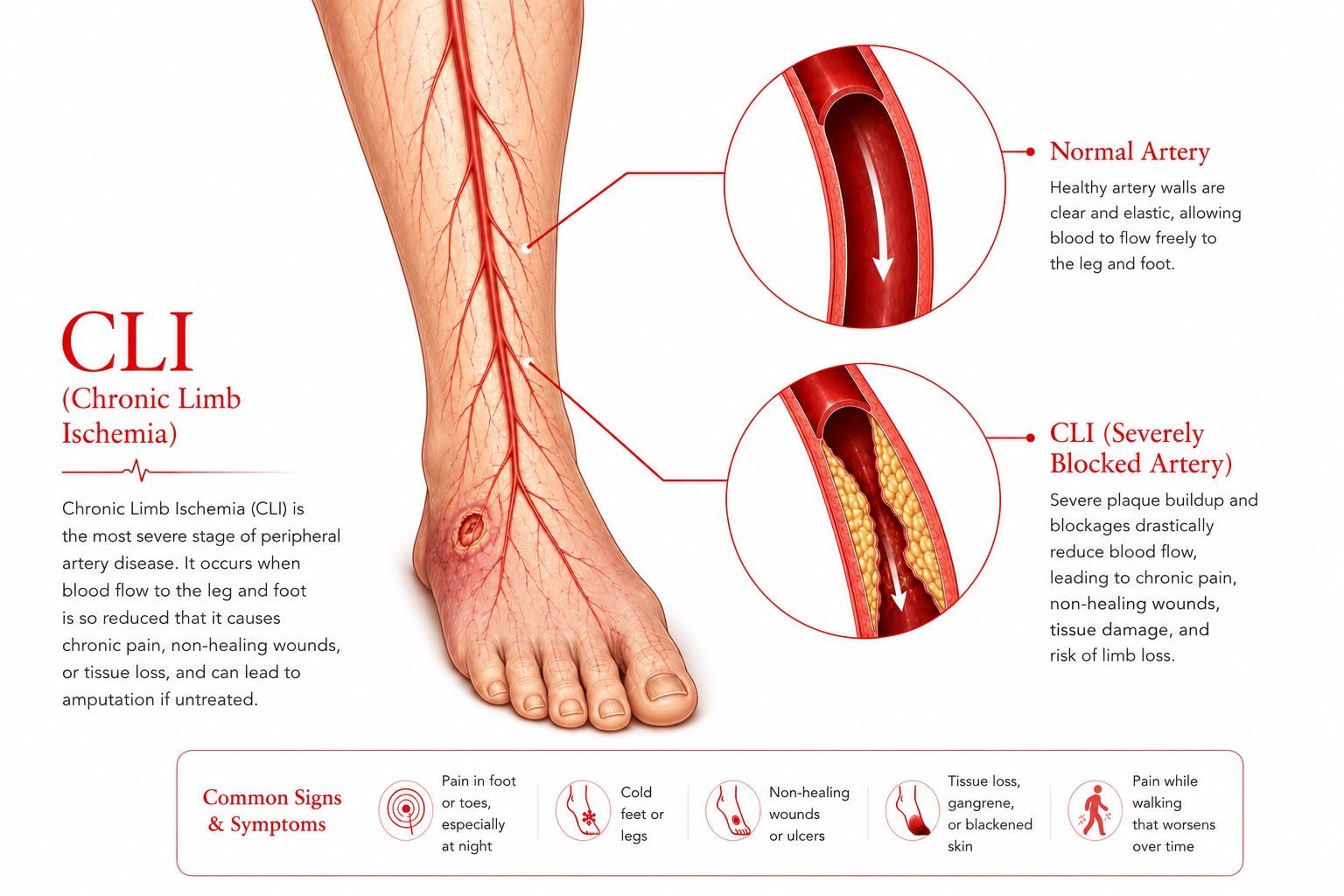
Common CLI symptoms.
Unlike earlier PAD, where pain happens with walking, CLI causes symptoms even at rest. Any of these signs deserves urgent evaluation.
- Foot pain at rest, especially at night when the foot is elevated
- Relief when the foot dangles off the side of the bed
- Non-healing wounds or ulcers on the toes, foot, or lower leg
- Discoloration: pale, blue, dusky, or blackened skin
- Coldness in the foot, often compared to the other side
- Loss of hair and shiny, thin skin on the foot and lower leg
- Gangrene: dead tissue, often starting on a toe
- Weak or absent pulse in the foot
Get your circulation assessed.
Leave your details and one of our team will call you back shortly to arrange your appointment.
Who is most at risk.
- Diabetes: by far the largest driver of CLI
- Smoking (current or past)
- Chronic kidney disease, especially on dialysis
- Long-standing high blood pressure or cholesterol
- Advanced age
- Prior PAD or vascular disease
- Prior foot wound or amputation: strong predictor of recurrence
- Family history of vascular disease
When to see a vascular specialist.
- Foot pain at rest, especially at night
- Any non-healing wound on the foot or lower leg
- A toe or area of skin that is dark, blue, or black
- A foot that suddenly becomes pale, cold, and painful
- A recommendation for amputation: please get a second opinion before scheduling
If a foot is suddenly cold, numb, painful, and pale. That is acute limb ischemia, a true emergency. Call our office immediately or go to the nearest emergency room. Hours matter.
How MVM treats CLI.
Patients and referring physicians choose MVM for critical limb ischemia because we treat it as the emergency it is, fast diagnosis, fast revascularization, and an explicit limb-preservation mindset.
- Urgent evaluation for limb-threatening symptoms. We don't make CLI patients wait.
- In-office vascular testing. Ankle-Brachial Index (ABI), toe pressures, and Doppler ultrasound at the first visit.
- Endovascular limb salvage. Angioplasty, stenting, and atherectomy for below-the-knee and pedal arteries performed at our Kendall Procedural Suite.
- Second-opinion friendly: especially before amputation. A meaningful percentage of patients told they need amputation are candidates for revascularization. We see these referrals quickly and review the imaging directly.
- Coordinated wound care. Partnerships with podiatry and wound-care specialists across South Florida for advanced and non-healing wounds.
- One team, full continuum. The team that diagnoses you also performs the procedure and manages follow-up.
How we diagnose CLI at MVM.
Most patients leave their first visit with a definitive plan, including timing of any procedure.
- Focused history and exam: including pulse check and full foot inspection
- Ankle-Brachial Index (ABI) and toe pressures: quick, non-invasive in-office tests
- Vascular ultrasound: Doppler imaging of leg arteries performed in our office
- Advanced imaging: CT angiography (CTA) or MR angiography (MRA) to map disease before a procedure
- Wound assessment: including depth, infection signs, and circulation
- Diagnostic angiography: direct artery imaging in the procedural suite, often done at the same visit as intervention
Treatment options.
The driving goal in CLI is to restore blood flow fast enough to save the limb. Modern endovascular techniques have changed what's possible, many patients who would have been told amputation was the only option are now candidates for revascularization.
Medical management and risk reduction
Every CLI patient needs aggressive medical therapy alongside revascularization: smoking cessation, blood pressure and cholesterol control, diabetes optimization, antiplatelet therapy, and statins. These treat the underlying atherosclerosis and reduce future cardiovascular events.
Minimally invasive revascularization
At our Kendall Procedural Suite, we perform:
- Balloon angioplasty: including specialty drug-coated balloons for below-the-knee disease
- Atherectomy: physically removes plaque from heavily diseased segments
- Stenting: holds opened vessels in place when needed
- Pedal loop reconstruction: restoring blood flow into the foot and lower leg by reopening the pedal arteries themselves, often when the rest of the leg arteries are also diseased
- Deep venous arterialization: when arterial pathways can't be reopened, blood flow can be rerouted through a vein to bring oxygen to ischemic tissue, an alternative circulation pathway used in advanced limb-salvage cases
These procedures are performed through a small access point in the groin, wrist, or even the foot. Many CLI patients are home the same day.
Coordinated wound care and follow-up
Restored blood flow lets wounds heal, but wound care, offloading, and infection management run in parallel. We coordinate with podiatry and wound-care specialists, and follow patients closely until the wound is closed and the limb is stable.
CLI FAQs.
I was told I need an amputation. Should I get a second opinion?
Yes, absolutely. A meaningful percentage of patients told they need amputation are candidates for limb-saving endovascular procedures. The fact that one team thinks the limb can't be saved doesn't mean another team will reach the same conclusion. We see second-opinion CLI referrals quickly and review the imaging directly. Call our office and tell the team it's a CLI or amputation question.
How fast does CLI need to be treated?
CLI is a vascular emergency. Tissue loss progresses over days to weeks without restored blood flow. We aim to evaluate suspected CLI patients within 24 hours and proceed to intervention as quickly as imaging and medical optimization allow.
Can wounds really heal once blood flow is restored?
In most cases, yes, when wounds are well-cared-for, infection is controlled, and circulation is restored. Healing takes weeks to months and depends on wound size, location, and the patient's overall health.
Is the procedure painful or risky?
Endovascular revascularization is minimally invasive, performed through a small access point under local anesthesia and light sedation. The risks are real but generally low, and they are much smaller than the consequences of an amputation in most cases. We review the specific risks with you before any procedure.
Will I need another procedure later?
Possibly. Arteries treated for CLI can re-narrow over time, and the underlying atherosclerosis continues to evolve. We follow patients closely and reintervene when imaging or symptoms suggest a new narrowing has developed.
Schedule a CLI consultation.
Limb-threatening symptoms are moved to the front of the schedule. Tell the team it's a CLI or amputation question. Bring any prior imaging, your medication list, and photos of the affected foot.
Schedule a consultationSend us a CLI referral.
Limb-threatening ischemia is moved to the front of the schedule. Second-opinion referrals before planned amputation are explicitly welcomed and prioritized. We send the consult note back promptly.
Referral process